Quellen
European Association for the Study of the Liver (EASL). Electronic address: [email protected] et al. “EASL-EASD-EASO Clinical Practice Guidelines on the management of metabolic dysfunction-associated steatotic liver disease (MASLD).” Journal of hepatology vol. 81,3 (2024): 492-542. doi:10.1016/j.jhep.2024.04.03
Mandorfer et al. “Austrian multisociety consensus on metabolic dysfunction-associated steatotic liver disease : Austrian Society of Gastroenterology and Hepatology (ÖGGH), Austrian Society of Diabetology (ÖDG), Austrian Society of Obesity (ÖAG).” Wiener klinische Wochenschrift vol. 137,Suppl 10 (2025): 307-319. doi:10.1007/s00508-025-02617-4
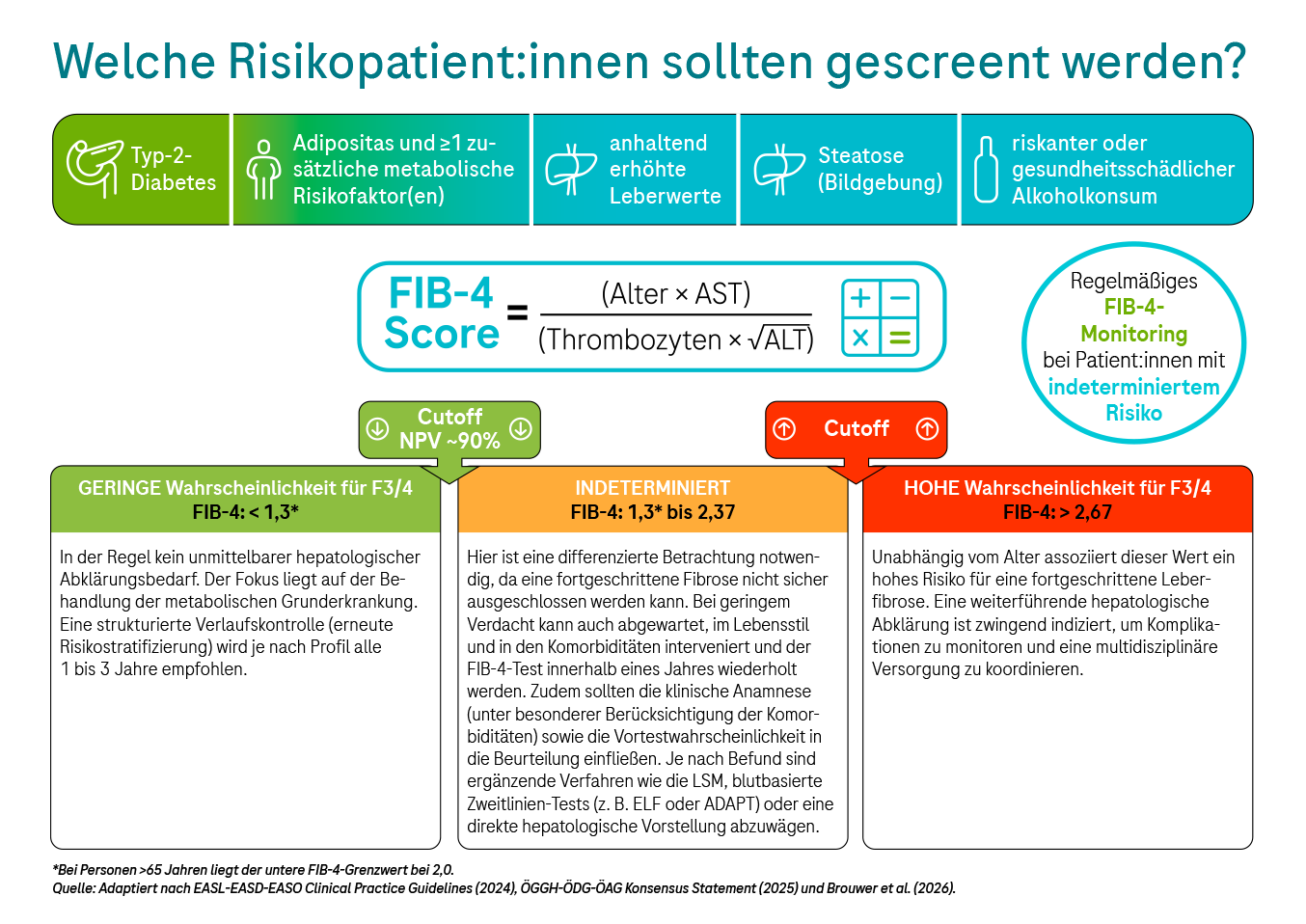
Brouwer et al. “Steatotic liver disease trajectory: A holistic EASL guidance on the multidisciplinary approach to screening and patient management”, JHEP Reports, Volume 0, Issue 0, 101798 (2026)
Sterling et al. Development of a simple noninvasive index to predict significant fibrosis in patients with HIV/HCV coinfection. Hepatology. 2006;43(6):1317-1325. doi:10.1002/hep.21178
Rinella et al. “From NAFLD to MASLD: updated naming and diagnosis criteria for fatty liver disease.” Journal of lipid research vol. 65,1 (2024): 100485. doi:10.1016/j.jlr.2023.100485
Targher et al. “Metabolic Dysfunction-Associated Steatotic Liver Disease.” The New England journal of medicine vol. 393,7 (2025): 683-698. doi:10.1056/NEJMra2412865
Younossi et al. “The global epidemiology of NAFLD and NASH in patients with type 2 diabetes: A systematic review and meta-analysis.” Journal of hepatology vol. 71,4 (2019): 793-801. doi:10.1016/j.jhep.2019.06.021
SPECTRA Marktforschungsinstitut. „Umfrage zur Leberdiagnostik in der Praxis“ Durchgeführt im Auftrag der Roche Diagnostics GmbH (2025). Abrufbar unter: https://dianews.roche.com/rs/106-RRW-330/images/Leber%20FactSheet%20Accu-Chek.pdf